Storm Reid spent the first weekend of 2024 doing something most college juniors never imagine.
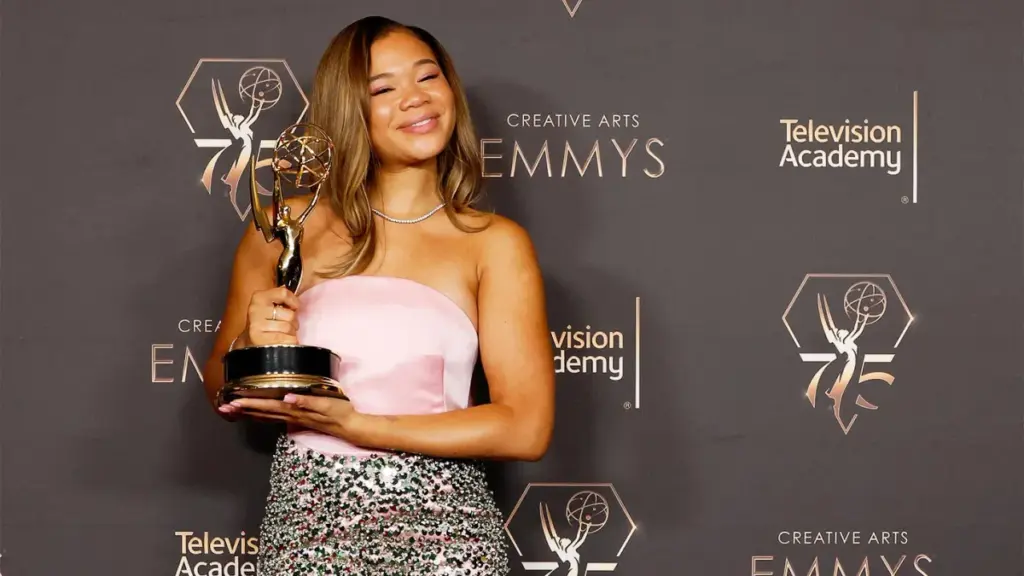
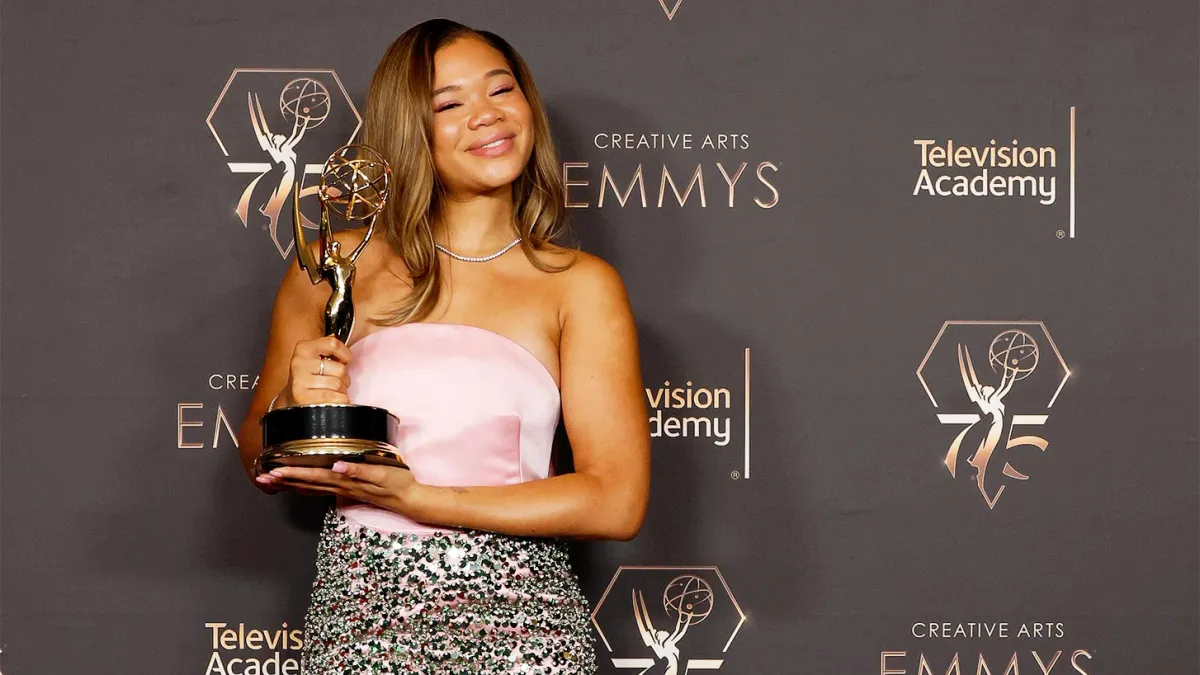
On January 6, at the 75th Creative Arts Emmy Awards in Los Angeles, the 20‑year‑old USC student walked onstage and accepted the Emmy for Outstanding Guest Actress in a Drama Series for her performance as Riley Abel in The Last of Us episode “Left Behind.”
The win did more than add another trophy to HBO’s shelf.
It made Reid the youngest winner in any guest acting category in Emmy history, according to multiple awards trackers, and it helped The Last of Us secure a leading eight Creative Arts Emmys in its first season.
It also quietly closed a loop that started years earlier on another HBO phenomenon, Euphoria, where Reid first learned to live inside the minds of messy, hurting teenagers.
For fans of The Last of Us, the question almost asks itself.
How did Gia Bennett, Rue’s quieter little sister in Euphoria, become Riley Abel, Ellie’s loud, stubborn, doomed first love, and end up making Emmy history along the way?
From Atlanta to HBO: How Storm Reid Arrived at This Moment
Reid’s Emmy night at the Peacock Theater did not come out of nowhere.
She has been working for more than a decade, starting far from the Boston QZ or East Highland High.
Storm Reid was born July 1, 2003, in Atlanta, Georgia.
She began acting professionally in 2012 and picked up early credits in films like 12 Years a Slave (2013) and the sci‑fi drama Sleight (2016).
Her first major breakthrough came in 2018, when Ava DuVernay cast her as Meg Murry in Disney’s A Wrinkle in Time.
That lead role brought her Teen Choice and NAACP Image Award nominations and, by her own account, showed her how representation on screen could affect young audiences.
After A Wrinkle in Time, Reid kept moving between film and television.
She appeared in Don’t Let Go (2019) and The Invisible Man (2020), and she played a key part in Ava DuVernay’s Netflix miniseries When They See Us (2019).
In 2023 she starred in the thriller Missing and the horror sequel The Nun II, solidifying her status as a go‑to young lead across genres.
But her most visible footprint has been on HBO.
First with Euphoria.
Then with The Last of Us.
Euphoria’s Gia Bennett and the Zendaya Connection
Reid joined Euphoria when the series premiered on HBO in June 2019.
She plays Georgia “Gia” Bennett, the younger sister of Zendaya’s character Rue Bennett.
Across the show’s first two seasons, which aired in 2019 and early 2022, Gia watches Rue’s addiction tear through their family, often from the margins of the story but rarely from its emotional outskirts.
Reid has called Euphoria a “cultural phenomenon” and said she is “so glad that that’s a part of my legacy and that I was a part of such a cultural phenomenon.”
The phrase is hardly an exaggeration.
The series generated constant social‑media conversation, fashion trends, and think pieces about teen mental health, drugs, and social media pressure.
Working opposite Zendaya also gave Reid something more personal.
She has described a real‑life big‑sister dynamic with her co‑star.
On the People Every Day podcast in 2023, Reid explained, “I always go to her for advice… She’s always just super honest, super blunt, in the most loving, gentle way.”
She regularly refers to Zendaya as “my big sis” and has said Zendaya is “always a phone call away” when she needs guidance about “growing up in Hollywood.”
Zendaya’s awards run formed part of the backdrop to Reid’s own Emmy journey.
Zendaya won two Primetime Emmys for Outstanding Lead Actress in a Drama Series for playing Rue, first in 2020 and again in 2022, making her the youngest two‑time Emmy acting winner and the first Black woman to win that category twice.
Reid watched that happen from the ensemble, learning how awards attention can follow a risky, youth‑centered drama.
By late 2024, though, their on‑screen sisterhood had reached a natural pause.
Reid confirmed in November that she will not return for Euphoria Season 3, which HBO has framed as a time‑jumped continuation of the story, pushing the core cast into adulthood.
“Unfortunately, Gia’s not returning for the third season,” she said, while emphasizing how “indebted” she felt to the show’s cast, crew, and HBO.
That departure cleared space on her schedule.
By then, Riley Abel had already arrived.
From East Highland to the Boston QZ: Becoming Riley Abel
When The Last of Us debuted on January 15, 2023, HBO was attempting something unusual: a prestige adaptation of a beloved video game, positioned for awards consideration.
The series eventually received 24 Primetime Emmy nominations and became widely cited as the first live‑action video‑game adaptation to break fully into the awards mainstream.
Reid did not appear until Episode 7, “Left Behind,” which aired on February 26, 2023.
The episode adapts the 2014 Naughty Dog game expansion The Last of Us: Left Behind and was written by series co‑creator Neil Druckmann and directed by Liza Johnson.
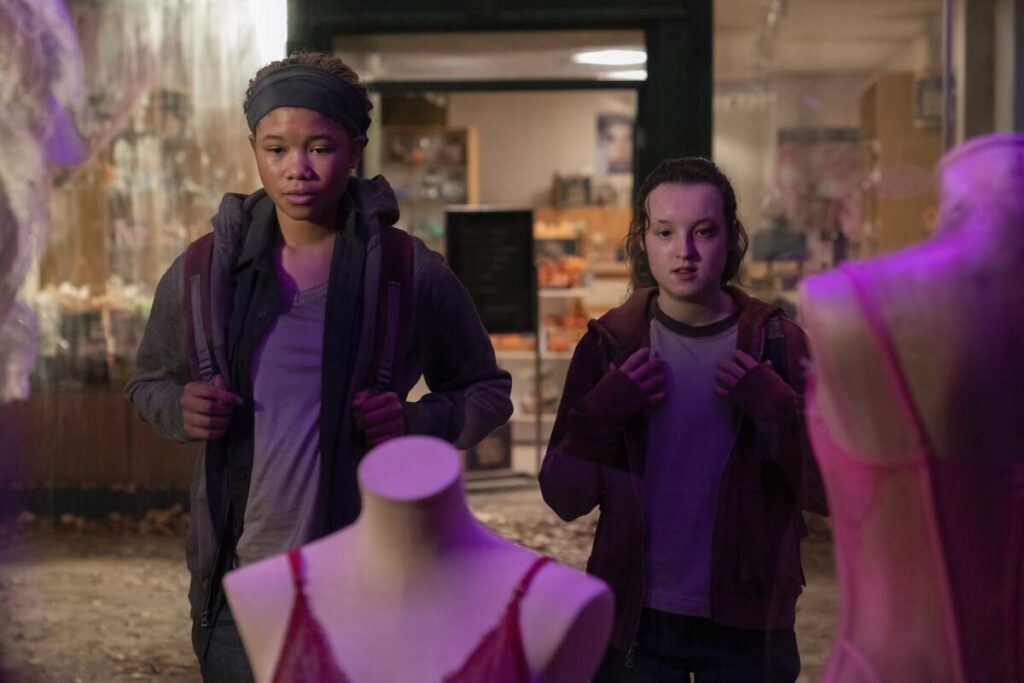
It runs 55 minutes and shifts between Ellie caring for an injured Joel in the present and a flashback to her life in a Boston FEDRA boarding school.
In that flashback, Ellie sneaks out with her former roommate and best friend, Riley Abel, who has joined the Fireflies.
They break into an abandoned mall that still has power.
Together they ride a carousel, crowd into a photo booth, play in an arcade, and wander through a Halloween store.
The night slowly turns from mischief to something more intimate, culminating in a kiss before both girls are bitten by an infected.
The episode became an instant touchpoint for the series.
“Left Behind” drew 7.7 million viewers in the United States on its first day across linear HBO and streaming, part of a viewership climb that would eventually make The Last of Us HBO’s most‑watched debut season, averaging almost 32 million viewers per episode by May 2023.
On linear TV alone, “Left Behind” attracted 1.083 million viewers and a 0.37 ratings share, with HBO Max users streaming roughly 261 million minutes within three hours of release.
Critics responded just as strongly.
On Rotten Tomatoes, “Left Behind” holds a 97% approval rating based on 32 reviews, with an average score of 8.4/10.
The site’s critics’ consensus calls it a “heartbreaking duet” between Bella Ramsey and Storm Reid.
Den of Geek praised the episode’s mall visuals and emotional focus, while gaming outlet Push Square highlighted how faithfully the show captured the tone of the original expansion.
Reid has been clear about how she thought herself into Riley’s head, and how that process echoed her time as Gia.
In a Teen Vogue interview about Episode 7, she noted that “even though they have different experiences and different circumstances, at the end of the day, they’re just two young women trying to figure it out.”
She said both Gia and Riley are “trying to figure themselves out” and “trying to save themselves,” each “through the theme of love.”
For Gia that love is mostly familial, wrapped around Rue.
For Riley it is romantic and tied to the fragile notion of found family inside a collapsing world.
That emotional overlap made the jump from East Highland to the Boston QZ feel surprisingly smooth.
But The Last of Us also gave Reid something Euphoria never could: direct awards recognition.
Breaking Emmy Ground for The Last of Us
At the 75th Creative Arts Emmy Awards on January 6, 2024, held at the Peacock Theater in Los Angeles, The Last of Us dominated the drama categories.
The series won a leading eight awards, including Outstanding Guest Actor in a Drama Series for Nick Offerman, several technical prizes, and Outstanding Guest Actress in a Drama Series for Storm Reid.
The Television Academy lists her win specifically for “The Last of Us – ‘Left Behind’.”
Coverage following the ceremony noted that her victory made her the youngest winner in any guest acting category in Emmy history, surpassing Lee You‑mi, who had previously held the record for Squid Game in 2022.
Although some outlets initially described her as 19, her documented birthdate and the ceremony timing place her at 20 years old when she accepted the award.
Reid treated the Emmy as both personal validation and something larger.
In interviews around the win, she said, “This is proof you can do anything. I’m just a young girl from Atlanta, Georgia.”
She described The Last of Us as the project that allowed her to “really, re‑fall in love with storytelling,” adding that Riley reinforced her passion for meaningful stories.
Just as notably, she defined the win in terms of visibility.
She said she hoped her work on the show would be “a representation for young women, young Black women, young, queer Black women.”
For a video‑game adaptation, a genre once mostly ignored by major awards, the symbolism hit hard: The Last of Us was now not only an Emmy‑nominated series, but one whose breakout guest star was explicitly framing her recognition in terms of race, gender, and queerness.
Taken alongside Zendaya’s two Euphoria Emmys, Reid’s trophy gave HBO something unusual.
Two young Black women, both initially known for playing complicated teenagers, had now turned that work into serious award hardware.
Storm Reid, Gen Z, and Life as a USC Student
There is another layer to Reid’s Emmy story that has resonated strongly with younger viewers.
While she was filming The Last of Us and riding the awards circuit, she was also dealing with essays, finals, and campus Wi‑Fi.
Reid enrolled at the University of Southern California (USC) and studied in the School of Dramatic Arts, majoring in acting with a minor in African American Studies.
In a 2023 People interview, she explained that on campus she wanted to be “just Storm the student.”
She described herself riding a scooter to class in sweats, going to football games, and doing typical late‑night walks with friends.
She said she had long wanted to do “young‑people things” such as parties, staying out late, and attending sports events, even while maintaining a full slate of professional work.
Balancing those worlds was not always glamorous.
At the TIME Women of the Year Gala, she talked about hitting serious “senioritis” during her final year.
She admitted there were days when she cried in her car under the pressure of finishing college while sustaining a career.
Reid graduated from USC’s School of Dramatic Arts on May 15, 2025, at age 21.
She marked the occasion on Instagram, calling her choice to attend USC “life‑changing” and thanking her support network and faith.
Importantly, she also reminded critics that she had attended USC full time, acted full time, and won an Emmy while still a junior in college.
That last point became a flash moment in Gen Z discourse.
When a TikTok user mocked college as a mere “flex,” Reid responded that higher education “was for me.”
She emphasized that she worked and studied full time, pointed out USC’s competitive acceptance rate, and again mentioned earning an Emmy at 20 while in school.
For many young viewers navigating similar debates about the value of college, student debt, and hustle culture, her stance felt pointedly familiar.
Representation, Activism, and Why Gen Z Sees Her
Reid’s appeal to Gen Z is not only about age and Instagram posts from campus.
It rests on how she talks about her work, and who she says it is for.
As early as A Wrinkle in Time, she noticed the impact of representation.
She has recalled young girls approaching her to say they were grateful to “see a girl who looks like me save the world.”
Experiences like that pushed her to choose projects “very intentionally,” seeking stories that spark progressive conversations and highlight “people and situations that are underrepresented,” especially young girls.
Teen Vogue profiles position her within a politically aware generation.
One feature notes that, like many of her peers, she has a “courtside seat” to issues such as equal rights, the pay gap, and white supremacy.
Reid describes herself as an “active‑learner, active‑thinker, active‑listener,” slightly wary of the label “activist” but committed to using her platform to lift people up.
She has participated in youth‑oriented political content, including Teen Vogue videos encouraging voting and discussing student‑debt stress from a young person’s perspective.
All of that folds back into how she frames Riley and Gia.
These characters are not just jobs; they are opportunities to put complex young Black girls at the center of prestige television.
So when Reid says her Last of Us work is for “young women, young Black women, young, queer Black women,” it tracks with a decade of choices.
Her Emmy, in that sense, is not only a career highlight.
It is part of a longer project to keep that kind of representation visible in spaces, like major awards, where it has historically been rare.
What Happens Next
By the time Storm Reid accepted her Emmy in January 2024 and walked at USC graduation in May 2025, she had already linked three very different worlds.
She helped define a “cultural phenomenon” on Euphoria as Gia Bennett, crossed into blockbuster genre storytelling with The Last of Us, and lived the daily grind of college life in Los Angeles.
She will not be part of Euphoria’s planned third season, and HBO has not announced any further Last of Us appearances for Riley.
But the legacy of “Left Behind” is already fixed.
One self‑contained, 55‑minute episode brought 7.7 million viewers on its first day, earned a 97% Rotten Tomatoes score, helped The Last of Us to eight Creative Arts Emmys, and turned its guest star into the youngest guest‑acting winner in Emmy history.
For fans of The Last of Us, it also did something simpler.
It gave Ellie’s backstory a face and a voice that feel firmly of this generation, from a performer who spent her off days writing papers and racing a scooter between USC buildings.
Storm Reid’s path from Gia to Riley shows how much prestige television about teenagers has shifted in the last decade.
These are no longer side characters in someone else’s drama.
They anchor Emmy campaigns, headline HBO schedules, and, in Reid’s case, walk across graduation stages with statuettes waiting at home.
For a series built on the idea that love can be both saving and catastrophic, there is a certain neatness in the fact that its most celebrated standalone episode belongs to two young women trying, as Reid puts it, “to figure it out” through love.
In that way, her Emmy is not just a win for a guest role in a popular show.
It is another sign that the stories at the center of The Last of Us now belong, very clearly, to the generation living them.